



Violence Against Parties: Examining AfD Attacks

Daily Monitor
September 25, 2026
Violence Against Parties: Examining AfD Attacks
Are AfD members truly targeted every third day? A deeper look into the statistics reveals complexities.
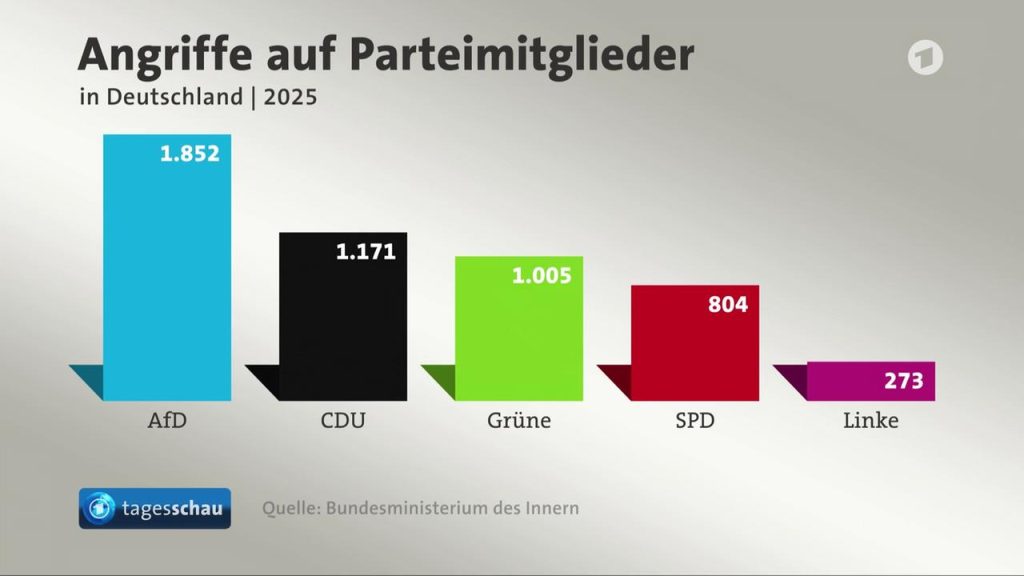
The issue of political violence in Germany has sparked heated debates, particularly concerning the far-right Alternative for Germany (AfD) party. A recent government report suggests that AfD representatives were victims of 121 violent incidents in the past year, averaging one attack every three days. These acts range from physical assaults to arson and theft. However, investigative findings by the Frankfurter Allgemeine Zeitung (F.A.Z.) raise questions about the accuracy and context of these statistics.
One illustrative case involves an AfD member in Rhineland-Palatinate who suspected tampering with his car’s wheel bolts. While the individual attributed the act to political opponents, the investigation was inconclusive, and the case was dismissed due to a lack of evidence. Despite this, the incident was recorded as a politically motivated crime against an AfD representative, highlighting the subjective nature of such classifications. The criteria for inclusion in the statistics rely heavily on police reports at the time of filing, which may not always reflect verified motives or outcomes.
Further scrutiny reveals additional ambiguities. For instance, a fire that destroyed a sport boat and trailer belonging to an AfD member in Bavaria was initially suspected to be arson. Yet, investigators could not establish a political motive or identify a perpetrator, leading to the case being closed. Even AfD spokespersons, such as Kerim Erdem from Miltenberg, admit uncertainty about whether such incidents are politically motivated, underscoring the difficulty of drawing definitive conclusions.
The complexity deepens when examining cases where AfD members themselves may have contributed to confrontations. In Göttingen, a clash between AfD members and residents of a leftist housing project resulted in allegations of dangerous bodily harm. Investigators suggest that both parties played roles in escalating the situation, complicating the narrative of victimization. Similarly, delays in reporting incidents, such as those following a February 2025 campaign event featuring Alice Weidel, further muddy the waters, as months-long gaps hinder timely investigations.
These findings call for a nuanced understanding of political violence statistics. While the reported numbers highlight concerning trends, the lack of clarity regarding motives and circumstances demands caution in interpreting such data. As Germany grapples with rising political tensions, ensuring transparency and accuracy in documenting violence against party representatives remains essential for informed public discourse.
One illustrative case involves an AfD member in Rhineland-Palatinate who suspected tampering with his car’s wheel bolts. While the individual attributed the act to political opponents, the investigation was inconclusive, and the case was dismissed due to a lack of evidence. Despite this, the incident was recorded as a politically motivated crime against an AfD representative, highlighting the subjective nature of such classifications. The criteria for inclusion in the statistics rely heavily on police reports at the time of filing, which may not always reflect verified motives or outcomes.
Further scrutiny reveals additional ambiguities. For instance, a fire that destroyed a sport boat and trailer belonging to an AfD member in Bavaria was initially suspected to be arson. Yet, investigators could not establish a political motive or identify a perpetrator, leading to the case being closed. Even AfD spokespersons, such as Kerim Erdem from Miltenberg, admit uncertainty about whether such incidents are politically motivated, underscoring the difficulty of drawing definitive conclusions.
The complexity deepens when examining cases where AfD members themselves may have contributed to confrontations. In Göttingen, a clash between AfD members and residents of a leftist housing project resulted in allegations of dangerous bodily harm. Investigators suggest that both parties played roles in escalating the situation, complicating the narrative of victimization. Similarly, delays in reporting incidents, such as those following a February 2025 campaign event featuring Alice Weidel, further muddy the waters, as months-long gaps hinder timely investigations.
These findings call for a nuanced understanding of political violence statistics. While the reported numbers highlight concerning trends, the lack of clarity regarding motives and circumstances demands caution in interpreting such data. As Germany grapples with rising political tensions, ensuring transparency and accuracy in documenting violence against party representatives remains essential for informed public discourse.
Drafted & Edited by Investigative Desk | AboMatrix