



Battling Forest Fires Amid Hidden Explosives

Daily Monitor
September 17, 2026
Battling Forest Fires Amid Hidden Explosives
Germany faces fierce forest fires complicated by buried munitions, forcing evacuations and innovative firefighting tactics.
Germany is grappling with a series of devastating forest fires fueled by relentless heatwaves and dry conditions. Yet, the challenge extends beyond the flames themselves. In several regions, buried remnants of wartime munitions have turned firefighting into a perilous endeavor, with explosions further complicating efforts. The situation underscores the intersection of environmental crises and historical legacies, as emergency crews navigate both natural and man-made hazards.
One of the most critical incidents unfolded in the district of Bad Kreuznach, Rhineland-Palatinate, where a wildfire erupted on a steep hillside near the village of Traisen. The area, known for its munitions-laden soil, witnessed explosions that prompted the evacuation of approximately 650 residents. Authorities acted swiftly, establishing emergency shelters and offering hotel accommodations for vulnerable groups, including the elderly, the sick, and families with young children. Although homes in the evacuation zone remain safe for now, the precautionary measures highlight the unpredictable nature of the crisis.
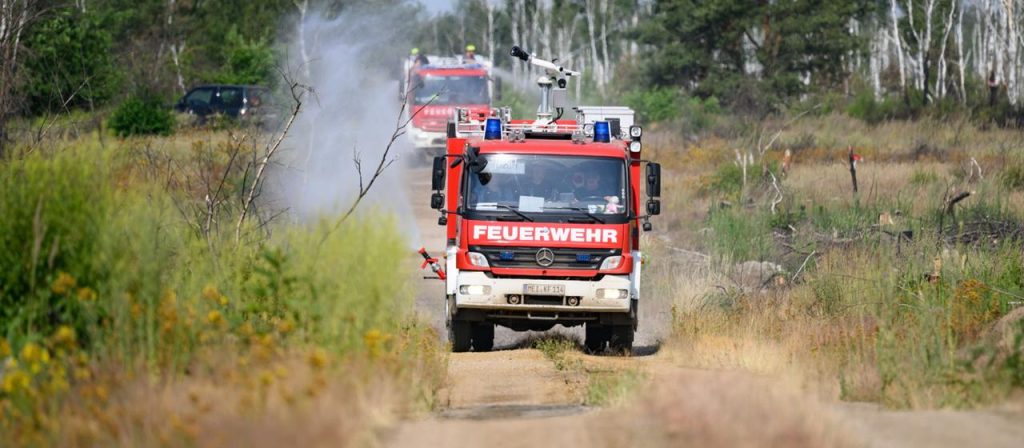
To protect firefighters from the dangers posed by explosive remnants, mobile water cannons operated remotely have been deployed. Bettina Dickes, the district administrator, lamented the fire’s impact on one of the region’s most treasured nature reserves, which is currently under consideration for UNESCO World Heritage status. “This is truly a tragedy,” she remarked, emphasizing the ecological significance of the area.
Meanwhile, in the Gohrischheide region, straddling the border between Saxony and Brandenburg, firefighters are battling another blaze in a munitions-contaminated zone. The area, which suffered its worst wildfire in decades just last year, remains vulnerable to rekindling due to strong winds and rising temperatures. Local officials have managed to contain the fire overnight but remain on high alert as weather conditions threaten to reignite the flames.
In Mecklenburg-Western Pomerania, a four-day battle against a major fire near Neustrelitz has finally brought the situation under control. However, the high temperatures in the soil and the presence of munitions continue to pose risks. Firefighters are now focusing on cooling the edges of a former Soviet tank shooting range to prevent flare-ups. Nearby, a solar park adds another layer of complexity to the operation.
Additional fires have been reported in Saxony-Anhalt, including a blaze in Tangerhütte caused by a suspected lightning strike and another in Blankenburg, where aerial firefighting resources were deployed. These incidents reflect the broader challenges posed by climate change, as Germany faces increasingly frequent and severe wildfires.
One of the most critical incidents unfolded in the district of Bad Kreuznach, Rhineland-Palatinate, where a wildfire erupted on a steep hillside near the village of Traisen. The area, known for its munitions-laden soil, witnessed explosions that prompted the evacuation of approximately 650 residents. Authorities acted swiftly, establishing emergency shelters and offering hotel accommodations for vulnerable groups, including the elderly, the sick, and families with young children. Although homes in the evacuation zone remain safe for now, the precautionary measures highlight the unpredictable nature of the crisis.
To protect firefighters from the dangers posed by explosive remnants, mobile water cannons operated remotely have been deployed. Bettina Dickes, the district administrator, lamented the fire’s impact on one of the region’s most treasured nature reserves, which is currently under consideration for UNESCO World Heritage status. “This is truly a tragedy,” she remarked, emphasizing the ecological significance of the area.
Meanwhile, in the Gohrischheide region, straddling the border between Saxony and Brandenburg, firefighters are battling another blaze in a munitions-contaminated zone. The area, which suffered its worst wildfire in decades just last year, remains vulnerable to rekindling due to strong winds and rising temperatures. Local officials have managed to contain the fire overnight but remain on high alert as weather conditions threaten to reignite the flames.
In Mecklenburg-Western Pomerania, a four-day battle against a major fire near Neustrelitz has finally brought the situation under control. However, the high temperatures in the soil and the presence of munitions continue to pose risks. Firefighters are now focusing on cooling the edges of a former Soviet tank shooting range to prevent flare-ups. Nearby, a solar park adds another layer of complexity to the operation.
Additional fires have been reported in Saxony-Anhalt, including a blaze in Tangerhütte caused by a suspected lightning strike and another in Blankenburg, where aerial firefighting resources were deployed. These incidents reflect the broader challenges posed by climate change, as Germany faces increasingly frequent and severe wildfires.
Drafted & Edited by Investigative Desk | AboMatrix