



Thuringian Politician Quits Party Over AfD Ties

Thuringian Politician Quits Party Over AfD Ties
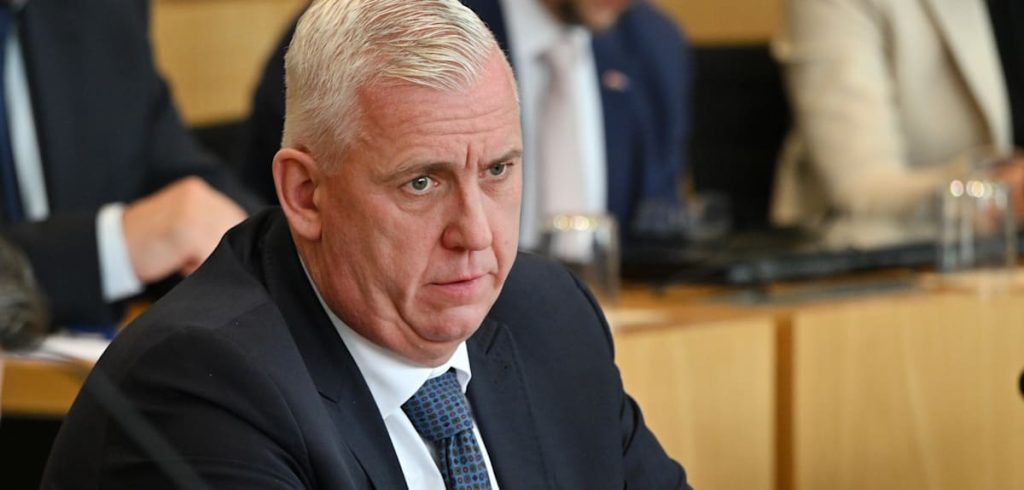
Matthias Herzog, a Thuringian lawmaker, exits Sahra Wagenknecht’s party citing concerns over potential collaboration with the far-right AfD.
Matthias Herzog, a member of the Thuringian state parliament, has announced his departure from the Bündnis Sahra Wagenknecht (BSW) party, citing growing discomfort with its evolving political direction and potential collaboration with the far-right Alternative for Germany (AfD). Herzog’s decision marks a significant moment in the ongoing internal conflict within the party, which has been grappling with ideological divisions and leadership disputes.
Herzog, who joined the BSW inspired by its founder Sahra Wagenknecht, expressed deep frustration over the party’s structural issues, including restrictive membership policies, poor communication, and concentration of power among a few individuals. He stated, “I can no longer credibly remain a member of a party where I constantly have to publicly distance myself from its actions.” Herzog also criticized Wagenknecht’s increasing alignment with the AfD, particularly in Saxony-Anhalt, where signals were sent that could pave the way for the AfD to assume governmental responsibility.
The BSW has been embroiled in heated debates over its strategic direction. The party’s federal leadership, including Fabio De Masi and Amira Mohamed Ali, has pushed for a break with the coalition involving the CDU and SPD in Thuringia, while regional leaders like Katja Wolf advocate for maintaining the current alliance, dubbed the “Thuringian Way.” The tensions escalated after the BSW’s federal leadership indicated willingness to support the AfD’s candidate for minister-president in Saxony-Anhalt, a move that many within the party, including Herzog, view as crossing a political red line.
Herzog emphasized that while he supports evaluating proposals based on merit rather than their origin, active collaboration with the AfD is unacceptable. “If we consciously enable the AfD to take on governmental responsibility, that’s a boundary I cannot accept,” he said. Despite his departure from the party, Herzog intends to retain his parliamentary mandate and continue supporting the coalition with the CDU and SPD in Thuringia. He reaffirmed his commitment to the “Thuringian Way,” stressing the importance of stability and reliability in governance.
Herzog’s resignation underscores the growing fractures within the BSW as it navigates contentious political waters. The party faces critical decisions at its upcoming special congress, where its future direction and alliances will be debated. As the political landscape in Thuringia and Saxony-Anhalt evolves, Herzog’s exit highlights the challenges of balancing ideological purity with pragmatic governance.
Edited and Prepared by AboMatrix